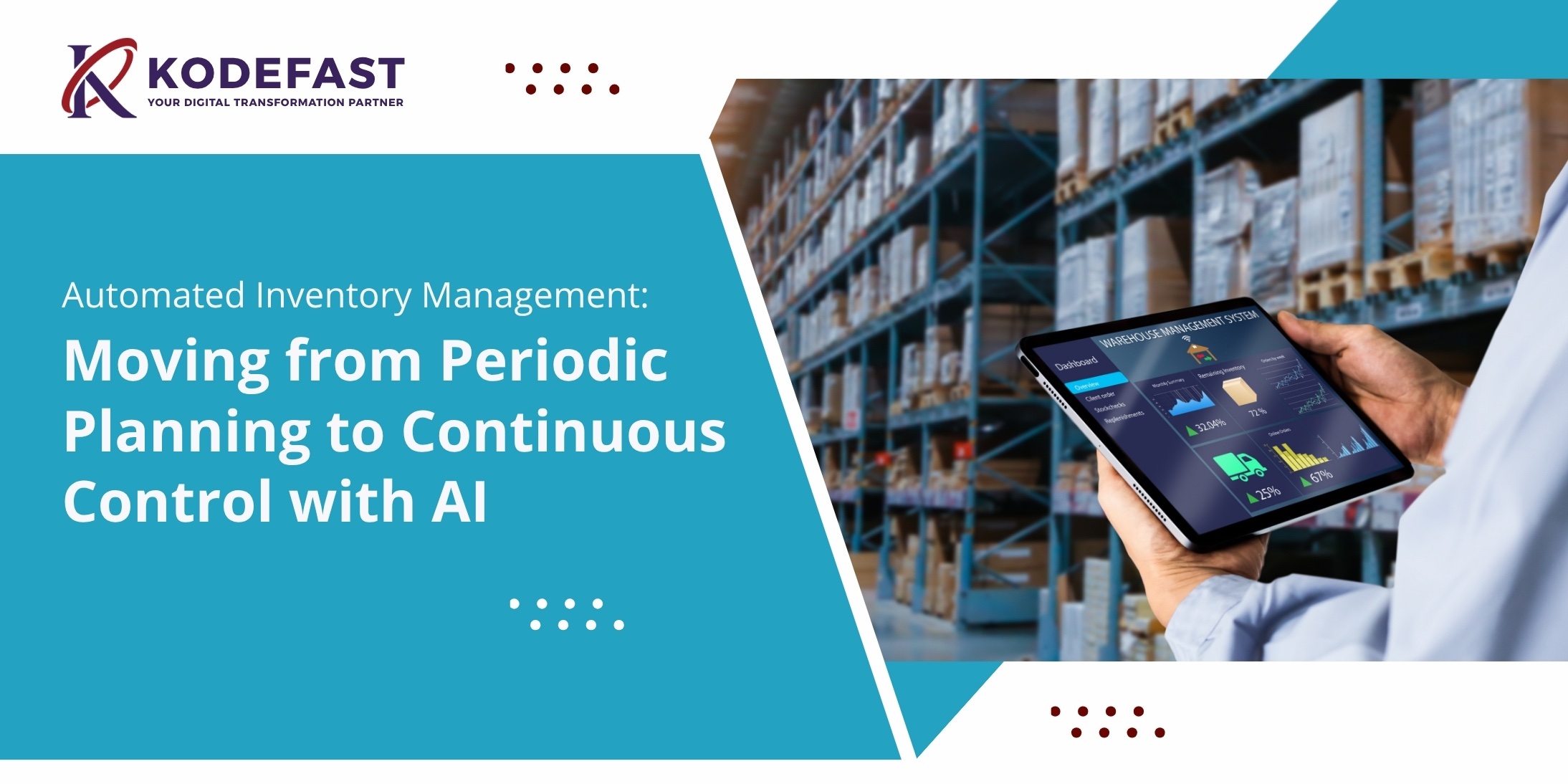
Automated Inventory Management: Why Businesses Are Ditching Periodic Planning for Continuous Control
Inventory is one of those things every business leader says they have under control, until they don’t.
Three days before anyone realized, a part ran out, and the production line stopped. The warehouse is stuffed with slow-moving stock ordered from last quarter’s numbers. Customer calls, frustrated that their order can’t ship. These are not edge cases. For most businesses managing inventory the traditional way, they happen all the time.
The problem is NOT lack of data. It inundates most organizations. The problem is the data arrives too late to do anything useful with it.
The Report That is Never on Time
Here is how traditional inventory management typically works. Someone pulls a report. The team reviews it in a weekly or monthly meeting. Decisions get made. And by the time action is taken the ground situation is already different.
This was built for a slower world with predictable lead times, reliable suppliers, and no wild swings in customer demand based on a competitor’s promotion or an unexpected disruption. That world is gone.
A delay by a supplier in one country can ripple through operations in a matter of days. Demand can surge or collapse with little warning. Managing inventory on a monthly review cycle in this environment is like navigating a highway using last year’s map. Technically still a map, but not particularly helpful.
The gap between identifying a problem and responding to it is where real money gets lost. Stock shortages do not politely wait for the next planning meeting. Excess inventory does not stop accumulating carrying costs while the team deliberates.
What Continuous Control Actually Means
The shift happening across industries is not really about software. It’s a fundamentally different philosophy on when things should be determined.
Periodic planning is where you look at the situation on a schedule and then you do something. Continuous control means: watch continuously, flag issues when they occur and act before they become problems.
The difference may seem simple but the operational impact is huge. This isn’t a team that sits for hours pulling reports and manually cross referencing spreadsheets from multiple locations. Continuous control means the system is doing that work 24/7, bringing up anomalies, flagging risks and recommending action automatically.
Procurement, operations and finance teams stop working from different snapshots of the same data and start working from a shared, real-time picture. That alone tends to weed out a whole class of problems that nobody formally owns, the kind that fall through the cracks.
Where AI Actually Makes a Difference
AI gets attached to a lot of inventory software marketing these days, so it is worth being specific about what actually moves the needle.
The clearest area of value is demand forecasting. Predicting customer demand, what they will want, when and how much, has always been a bit of an art and a bit of a science. Historical averages are useful, but they do not consider changing market conditions, seasonal variations or sudden external disruptions. With AI forecasting, historical trends and real-time signals are captured giving planning teams a far more accurate basis than any spreadsheet average ever could.
Automation has also created real leverage in the area of replenishment. An AI-based system can identify that stock for a particular item is trending toward a shortage before the shortage actually occurs, and flag or trigger a replenishment recommendation automatically. That is a completely different motion than waiting for a stock-out alert and then scrambling to fix it.
Continuous monitoring may not be the most visible aspect of operations, but it is one of the most important. An intelligent system detects issues early when inventory movements drift from expected patterns or when a supplier’s fulfillment rate begins to decline. What might take days to surface through traditional reporting can be identified and addressed within hours.
And perhaps the biggest practical shift: instead of inventory teams spending their day pulling data and building reports, they spend it acting on insights. The system does the watching. The people do the deciding.
The Problems That Keep Coming Back
Most organizations running traditional inventory systems are familiar with a short list of recurring headaches.
Forecasts always a little wrong, sometimes harmlessly, sometimes costly. Decisions to replenish that are just a little too late. Excess stock that piles up in one location while another runs short. A high manual workload that scales poorly as the business grows. Visibility gaps across facilities, channels, or product lines that nobody has a complete picture of.
These are not random failures. They are predictable outputs of systems designed to record inventory history rather than optimize inventory decisions in real time. More manual effort and more frequent reporting cycles help at the margins, but they do not fix the underlying problem.
The businesses making meaningful progress on inventory performance are the ones that have stopped trying to make periodic planning faster and started building systems that do not rely on periodic planning at all.
A Real Example
One manufacturing organization managing over 15,000 SKUs across multiple facilities had a problem that is quite common. They had plenty of inventory data, but never at the right moment. Teams were pulling information from multiple systems, manually reconciling it, and still dealing with stock shortages and excess accumulation that nobody saw coming until it had already created a problem.
After implementing KodeFast’s AI-powered inventory management platform, the change was less about new dashboards and more about shifting how and when decisions got made. Replenishment stopped being reactive. Forecasting became something the system always got better at, rather than something teams had to recreate from scratch every planning cycle.
Stockout incidents dropped 45 percent in a few months. Inventory carrying costs fell by 22 percent. Replenishment decisions that used to take days were happening in a fraction of the time. Visibility across facilities went from fragmented to unified. Forecasting accuracy improved significantly.
The numbers matter, but the more important change was structural. Inventory decisions started happening proactively instead of in response to problems that had already taken hold.
The Bottom Line
Inventory management has always been consequential. The difference is that business is moving faster than the tools most companies still use to manage it.
In a less demanding operating environment, periodic reviews, manual analysis and reactive replenishment were tolerable approaches. When supply chains are volatile, customer expectations keep rising and the cost of getting inventory wrong keeps climbing, it’s much harder to defend them.
The organizations that are moving forward are not necessarily the ones with more data or larger teams.They are the ones who have built systems that turn data into decisions fast enough to actually matter.
KodeFast helps businesses make that transition, from inventory management as a reporting function to inventory management as a real-time operational capability. Because knowing what happened last week is only useful if you had the chance to do something about it.