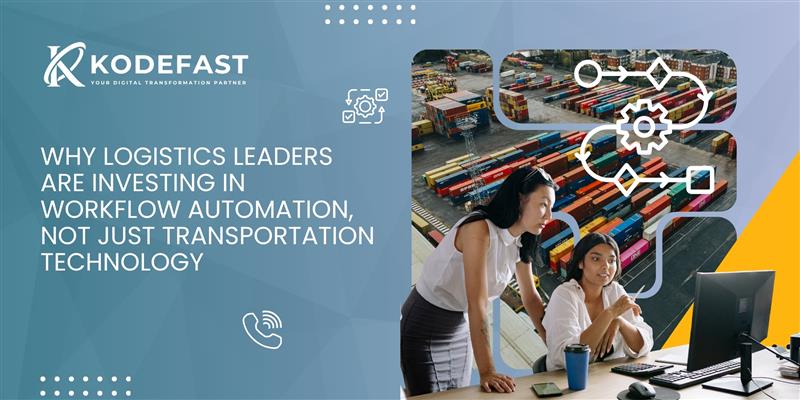
Why Logistics Leaders Are Investing in Workflow Automation, Not Just Transportation Technology
The most efficient logistics operations aren’t held back by their fleets. They’re held back by the workflows behind them. The trucks move fine. The tracking works. What breaks down is everything behind the scenes: the emails confirming a shipment status, the phone calls chasing a delayed pickup, the spreadsheet three people update differently every week. That gap between a well-run fleet and a chaotic back office is exactly where KodeFast has been spending its time lately, building the kind of logistics AI solutions that fix the parts of the operation nobody sees on a tracking map but everybody feels in the margins. Transportation technology solved the visible half of logistics years ago. The invisible half, the workflow behind every shipment, is where 2026’s real competitive gap is opening up.
The Trucks Were Never the Real Problem
For a long time, logistics investment meant better routing software, better telematics, a slightly smarter GPS. Those tools mattered, and most fleets are genuinely good at moving freight from point A to point B by now. But ask any operations lead where their week really gets eaten, and the answer rarely involves the trucks themselves. It’s that layer of coordination over the trucks, the part where humans manually push information between systems that were never meant to talk to each other.AI in logistics is finally starting to catch up with this reality. Forward-thinking operators are applying automation to the actual workflow, the handoffs, the confirmations, the exception handling that used to require a person watching five different screens at once, instead of bolting it onto dispatch software. But that change is more important than another routing upgrade ever could be, because the routing was never really the bottleneck.
Automating the Parts That Eat a Week
Logistics automation used to mean automating a single task, like generating a bill of lading automatically instead of by hand. Useful, but narrow. The real gains now come from automating the entire chain of small decisions that happen between a shipment leaving the warehouse and it reaching the customer’s dock. A delay at one stop should automatically update every downstream estimate, without a coordinator manually revising three systems and hoping nothing gets missed. This is where logistics digital transformation actually earns the phrase, rather than being another slide in a strategy deck. Real change means weaving together warehouse, transportation and customer-facing systems into one connected flow, not three tools that happen to be owned by the same company. When that connective layer works right a coordinator’s day looks totally different, fewer fires to put out, fewer status calls to make, more time spent doing things to improve the operation instead of just keeping it upright.
Where Conversational AI Actually Fits
Conversational AI in logistics gets dismissed sometimes as a gimmick, a chatbot bolted onto a support page. Done properly, it’s closer to a coordinator who never sleeps and never forgets to follow up.AI customer support for logistics now handles the exact questions that used to tie up a phone line all day: where’s my shipment, why is it delayed, what’s the new estimated arrival. Answering those immediately, accurately and without a hold queue, changes the customer relationship in ways that are hard to overstate once you’ve actually seen the difference. The human-like AI in logistics is what makes this work rather than what annoys people. Nobody wants to be talking to a script that can’t follow up a question. And the systems that win here are the ones that sound like a competent human being having a real conversation, understanding context, remembering what was already said, and escalating to a real human being the moment a situation actually calls for one.
Behind the Scenes - Generative Intelligence
Generative AI is quietly replacing logistics work that used to require a small army of analysts. Creating a shipment exception report, summarizing a week of delivery performance, writing a customer update that sounds like it was written by a human and not a template. None of this replaces the judgment of an experienced logistics professional. It just removes the hours they used to spend on documentation instead of decisions. It’s when you start combining this generative layer with actual operational data that AI-powered logistics platforms start to feel less like software and more like a genuinely competent extra team member who never gets tired of writing the same status update for the fortieth time that week.
The Bigger Picture: Supply Chain, Beyond Transportation
AI for supply chain management reconnects this workflow layer to areas of the business that transportation technology alone was never built to touch, such as inventory positioning, procurement timing and warehouse capacity. A delay seen in transportation usually started three steps earlier in the chain. Correcting the visible symptom only means that the same problem will reoccur a month later in a different disguise. AI in transportation and logistics working alongside this broader supply chain intelligence is what separates operators who are merely keeping up in 2026 from the ones actually pulling ahead. The distance between those two groups isn’t fleet size. It’s whether the workflow underneath the fleet is actually built to keep pace with how fast the business needs to move.
Where This Leaves Logistics Leaders
The leaders investing seriously right now aren’t chasing another routing upgrade. They’re looking at the workflow layer that never gets a headline but quietly determines whether an operation runs smoothly or limps from one fire to the next. That’s a harder problem to sell in a boardroom than a shiny new tracking dashboard, but it’s the one actually worth solving.KodeFast builds exactly this kind of platform, connecting workflow, customer communication, and supply chain intelligence into one system instead of another disconnected tool layered onto an already strained stack. If your back office is the part of the business quietly keeping you up at night, it doesn’t have to stay that way. Schedule a demo with KodeFast and see what logistics built around your actual workflow, not just your trucks, can do for your operation.