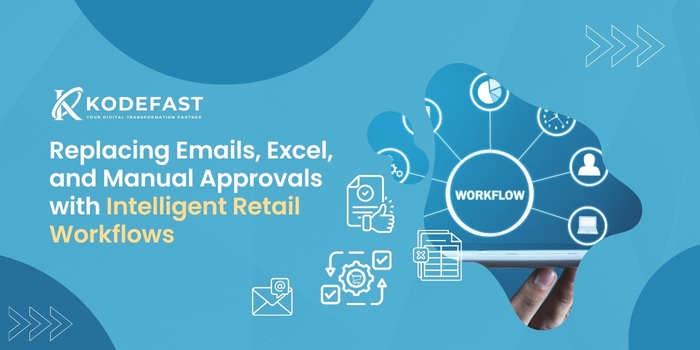
Replacing Emails, Excel and Manual Approvals with Intelligent Retail Workflows
A district manager needs sign-off on a markdown for three hundred units of last season's inventory sitting in a stockroom. She emails the regional director. He's traveling, replies from his phone two days later with a one-word "approved," except he replied to an older thread by mistake, so the finance team never actually sees it. Someone finally notices during month-end reconciliation, three weeks after the original request, by which point the units have taken another hit in value just sitting there. Nobody did anything wrong here exactly. The process just wasn't built to survive contact with how a real retail business actually moves. KodeFast spends most of its time these days inside exactly this kind of gap, building retail workflow management that treats an approval as something that should take minutes, not a game of email telephone that ends up costing a company real money every single month.
Where the Old Process Actually Breaks
Ask any retail operations leader how a markdown, reorder, or vendor exception actually gets approved and the honest answer is usually an email chain, a shared Excel tracker that three people update differently, and at least one approval that technically happened but left no clean record anywhere. It’s not people. The tools are, and the gap is most visible at the very times speed is most crucial: a fast-moving promotion, a vendor issue that needs to be solved the same day, a stock discrepancy that is actively costing money the longer it remains unresolved.Retail process automation exists specifically to close this gap, replacing the email-and-spreadsheet relay with a system where an approval request routes itself to the right person, tracks exactly where it sits at any given moment, and escalates automatically if nobody's acted within a set window. No more guessing whether a reply-all got missed. No more three-week surprises during reconciliation.
What Automate Retail Approval Processes Actually Looks Like
Automating retail approval processes doesn't mean removing the human decision from the loop. A markdown still needs someone with the authority to approve it, and a vendor exception still needs a real judgment call. What changes is everything around that decision: the request arrives with the context already attached, the right approver gets notified the moment it's their turn to act, and the whole chain is visible to anyone who needs to check on it without sending a single follow-up email.Retail approval workflow tools built properly also handle the edge cases that trip up manual processes constantly. An approver who's out of office gets automatically routed around instead of silently sitting on a request for a week. A request above a certain dollar threshold gets an extra layer of review without anyone having to remember the rule exists. None of this requires a bigger team. It just requires the system to actually carry the weight that used to fall on someone's memory.
Excel Was Never Built for This
Retail task management software has to compete with a genuinely stubborn opponent: the spreadsheet everyone already knows how to use. Excel is comfortable, familiar, and completely unsuited to tracking a live, moving process across multiple people and locations. Two versions of the same file inevitably drift apart. A formula breaks without warning and nobody notices until the totals stop matching. There is no real audit trail, just a filename with someone’s initials and a date that may or may not be when it was last touched.This is exactly why efforts to replace Excel with workflow automation work: a shared live system always trumps a file that gets passed around by attachment once complexity increases even a bit. Once a process affects more than a handful of people or more than one location, a spreadsheet ceases to be a tool and becomes a liability, hiding the very type of errors that only reveal themselves when it is far too late to make economic corrections.
Retail Operations Management Software Built for the Whole Chain
Well done retail operations management software connects far more than just approvals. In a real retail business, inventory counts, vendor communication, staffing requests and markdown decisions all touch each other constantly, and treating them as separate silos is exactly how a small delay in one area turns into a bigger problem somewhere else three days later. The retail automation software is based on this fact, providing every department with the same live view, rather than four disconnected views that are only compared in a monthly meeting.
Email Approvals - Why They Matter More Than You Think
The move to replace email approvals with workflow software is often written off as a small efficiency improvement, but the true impact is much bigger. Email is not an approval system, even though a ton of people use it like one. There is no built-in escalation, no reliable audit trail and no way to guarantee the right person even saw the request in the first place. A retail business making important decisions by email is basically gambling that nothing important gets lost in a busy inbox, a gamble that eventually loses.
Digital Transformation for Retail that Really Changes Your Day-to-Day
Retail digital transformation is a term that can mean anything from a new app to a complete platform overhaul, and that vagueness has made many retailers outright sceptical of the phrase. The version that actually matters is narrower and more practical: replacing the invisible administrative friction, the emails, the spreadsheets, the approvals that vanish into someone's inbox, with a system built to move at the speed retail actually requires.